


Ten days. Four astronauts. One arc around the Moon and back.
Not a landing. Not a simulation. A full-scale return to crewed deep-space flight, documented here as a technical-editorial mission archive.
Mission at a glance
A crewed lunar flyby, not a landing, and not a simulation.
Artemis II launched on April 1, 2026 and splashed down on April 10, 2026. NASA frames it publicly as an approximately 10-day mission, while the official mission duration lands at 9 days, 1 hour, 32 minutes.
It was the first crewed lunar flyby in more than 50 years, the first crewed flight of Orion and SLS together, and a systems-validation mission for the next steps of Artemis.
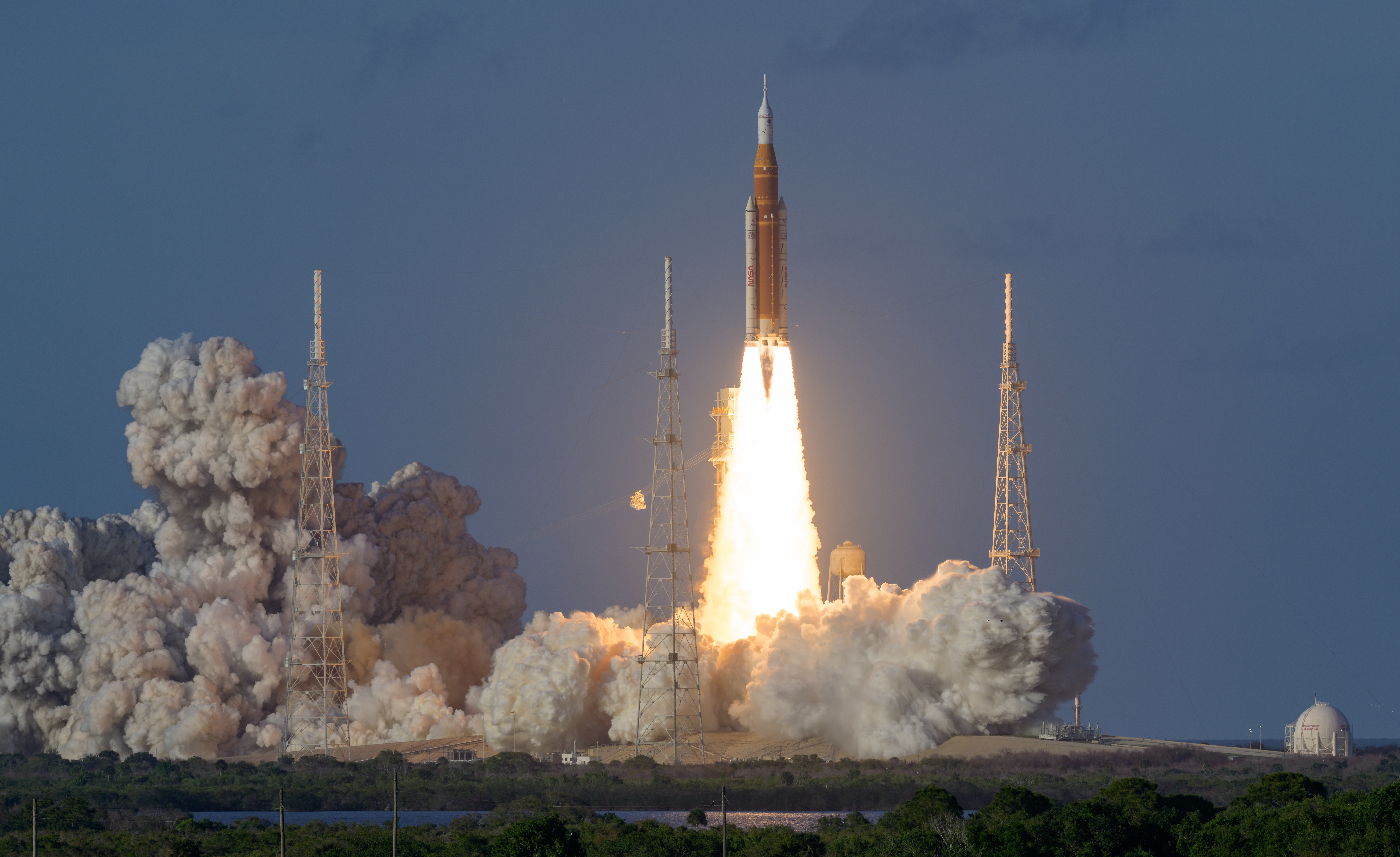
Launch to splashdown, April 1 to April 10, 2026.
Reid Wiseman, Victor Glover, Christina Koch, Jeremy Hansen.
First crewed return to lunar vicinity in more than 50 years.
First crewed flight of NASA's human deep-space stack.
The 10-day journey
A mission legible as chapters, not as isolated posts.
The core of the archive is the sequence from launch to splashdown. Each strip below ties location, crew activity, physics, and official NASA reporting into the same narrative line.
This is where the site stops being a gallery and starts acting like a mission record.
Day 0 · Liftoff and ascent
Artemis II lifted off from Launch Complex 39B, separated from the core stage, deployed Orion's solar array wings, and transitioned from launch energy into orbital flight.
Why this phase mattered
Launch is a speed-and-energy problem, not just an altitude problem. The vehicle must build the right velocity and staging sequence before Orion can leave Earth orbit safely.
Key metrics
- Launch time6:35 p.m. EDT
- Critical early configSolar array wings deployed
- Mission statusCrewed flight aboard SLS + Orion
Day 1 · Parking orbit and checkout
Orion completed initial activation, checkout, communications handoffs, and mission management review before committing to the translunar injection burn.
Why this phase mattered
Parking orbit buys time. It lets the mission verify vehicle health before spending propellant to leave Earth on a lunar trajectory.
Key metrics
- Decision pointMission management team poll
- Crew stateCheckout and systems validation
- Trajectory changeTranslunar injection queued
Day 2–3 · Translunar coast
After translunar injection, the crew settled into deep-space operations: cabin configuration, health demos, imaging prep, and trajectory assessment, including a canceled correction burn because the path was already on target.
Why this phase mattered
Deep-space flight is mostly coasting through gravitational geometry. Small planned burns exist, but the spacecraft spends most of its time following the orbit already set by the major burn.
Key metrics
- TLI burn5 minutes 50 seconds
- OTC-1Canceled due to accurate trajectory
- Deep-space operationsCabin prep, medical demos, optical comms
Day 4–5 · Lunar approach and Earthset
Flight day 4 moved into piloting demos, lunar science target review, and final approach prep. Flight day 5 added suit demonstrations, an outbound correction burn, entry into the lunar sphere of influence, and the run-up to the far-side flyby.
Why this phase mattered
As Orion approached the Moon, the relevant gravitational geometry shifted. The mission became less about leaving Earth and more about timing an exact free-return swing around another body.
Key metrics
- Closest approach planningApproximately 4,067 miles above lunar surface
- Lunar sphere of influenceEntered just after midnight EDT on April 6
- Observation windowSix-hour lunar science period
Day 6–8 · Historic flyby and return arc
Artemis II completed a seven-hour lunar flyby, set a new record for human distance from Earth, passed through planned loss of signal on the lunar far side, then began the return coast with correction burns, downlinked imagery, and more crew-operated tests.
Why this phase mattered
The Moon was not a stop. It was a gravity assist and turning point. The return trajectory depended on timing, relative velocity, and a free-return geometry that let the spacecraft arc back toward Earth.
Key metrics
- Maximum distance from Earth252,756 miles
- Farthest-human recordSurpassed Apollo 13
- Return burn15 seconds on Flight Day 7
Day 9 · Final corrections
The crew transitioned from deep-space routine into return configuration, completed another correction burn, and focused on re-entry prep, cabin stowage, and the final targeted burn before atmospheric entry.
Why this phase mattered
Small burns matter because re-entry is unforgiving. Tiny velocity changes made far from Earth map into large positional shifts later in the descent corridor.
Key metrics
- Second return correction9 seconds
- Final burn8 seconds · 4.2 ft/s
- Journey length694,481 miles
Day 10 · Re-entry and splashdown
Orion separated from the service module, performed the crew module raise burn, encountered plasma blackout, deployed drogue and main parachutes, and splashed down in the Pacific before recovery by NASA and U.S. military teams.
Why this phase mattered
Re-entry is controlled energy shedding. The spacecraft trades kinetic energy for heat, drag, and staged deceleration, then hands the last part of the problem to parachutes and recovery crews.
Key metrics
- Atmospheric interface400,000 feet · Mach 35
- Peak crew loadUp to 3.9 Gs
- Splashdown8:07 p.m. EDT · Pacific Ocean
Physics of the mission
How Artemis II worked, phase by phase.
This section treats Artemis II as a sequence of physical problems: energy management, orbital transfer, lunar geometry, correction burns, atmospheric braking, and staged recovery.
The goal is not classroom formalism. It is mission relevance: what principle mattered, when it mattered, and what people usually get wrong about it.
Launch is about building the right speed and direction, not simply climbing upward.
The rocket must produce enough thrust to overcome weight, atmospheric drag, and gravity losses while continuously steering toward a trajectory that becomes orbital rather than purely vertical. The mission succeeds only if energy is delivered in the right direction and in the right staging sequence.
Core principles
Thrust-to-weight ratio, gravity losses, staging, velocity buildup
Why it matters
Without the correct ascent geometry, Orion never reaches the parking orbit and all downstream mission phases disappear.
Orbit is controlled falling, managed by speed rather than support from below.
A parking orbit gives the mission time to verify spacecraft health before spending the propellant needed to leave Earth. The spacecraft is still falling toward Earth, but it moves sideways fast enough that the surface curves away beneath it.
Core principles
Orbital velocity, centripetal motion, systems checkout
Why it matters
This phase separates launch survival from mission commitment. Once the translunar burn starts, the path becomes much harder to undo.
One burn changes the entire orbit family the spacecraft belongs to.
The translunar injection burn did not keep Orion under power all the way to the Moon. Instead, it changed the spacecraft's velocity enough to leave Earth orbit and enter a long, stretched trajectory that intersects lunar space.
Core principles
Delta-v, orbital transfer, propulsive impulse
Why it matters
This is the decisive maneuver that turns an Earth-orbiting spacecraft into a Moon-bound spacecraft.
Most deep-space flight is navigation through gravitational geometry with engines mostly off.
Once the major burn is complete, the spacecraft mostly coasts. Corrections are small because the heavy work has already been done. This is why a canceled correction burn can be good news: it means the earlier solution was already precise enough.
Core principles
Inertia, free-flight trajectory, correction burns
Why it matters
It corrects the common misconception that deep-space travel is continuous powered flight.
The Moon acts as a gravitational turning point, not just a destination to look at.
A flyby uses the Moon's gravity to bend Orion's path. The spacecraft does not stop and restart; it moves through a shaped trajectory that trades direction and timing against lunar gravity. That is why the far-side pass and closest approach are mission-design events, not scenic extras.
Core principles
Free-return trajectory, patched conics, sphere of influence
Why it matters
This is the mission's structural center. It proves a crewed cislunar loop, not just a launch and a recovery.
Tiny burns in deep space can decide where the spacecraft lands days later.
Correction burns change velocity by small amounts, but applied early enough, those changes accumulate into large position shifts by the time Orion reaches Earth's atmosphere. That is why 1.6 or 5.3 feet per second matters in mission operations.
Core principles
Sensitivity to initial conditions, trajectory trimming, guidance and navigation
Why it matters
The return corridor is narrow. Small navigation errors become expensive or dangerous near re-entry.
Re-entry heating is not space being hot; it is the price paid for arriving too fast.
As Orion encountered the upper atmosphere at about 35 times the speed of sound, air in front of the capsule compressed violently and produced extreme temperatures around the heat shield. The spacecraft must convert enormous kinetic energy into heat while keeping the crew isolated from it.
Core principles
Kinetic energy, atmospheric compression, drag, heat shield ablation
Why it matters
Re-entry is the hardest energy-management problem in the mission's last minutes.
The final descent is a chain of deceleration systems, not one event.
Module separation, the crew module raise burn, drogue parachutes, main parachutes, and ocean recovery each solve a different part of the deceleration problem. By splashdown, the spacecraft has already survived the hardest thermal loads, but recovery operations are still part of the engineered return sequence.
Core principles
Entry angle, staged drag, parachute deployment envelopes, recovery operations
Why it matters
A mission is not done when the plasma disappears. It ends when the crew and spacecraft are safely handed to recovery teams.
Systems that made it possible
Vehicle, ground teams, tracking, and recovery as one architecture.
Artemis II only works if the public can read it as a coherent chain. SLS, Orion, mission control, AROW, and recovery operations are not side notes to the mission. They are the mission's body.
Orion spacecraft
Orion is not just the capsule the public recognizes. It is the crew habitat, guidance node, communication relay point, re-entry vehicle, and survival architecture that had to remain coherent across launch, cislunar flight, re-entry, and recovery.
Space Launch System
SLS matters here because Artemis II is not a stand-alone capsule story. The mission depends on heavy-lift ascent performance, staging reliability, and a clean handoff from launch vehicle energy to Orion mission operations.
Mission control and tracking
The mission remained understandable because flight control teams translated telemetry, navigation data, and procedure execution into decisions. On a crewed lunar mission, legibility is part of safety.
AROW and trajectory visualization
NASA's Artemis Real-time Orbit Website turned abstract state vectors into a public-facing trajectory. That matters because orbital mechanics becomes more meaningful when position, timing, and distance are visible as motion.
Recovery operations
Splashdown did not end the engineering chain. Navy divers, helicopters, and the USS John P. Murtha completed the handoff from spacecraft return to crew recovery, medical evaluation, and post-flight inspection.
Crew and the human layer
Four astronauts changed the meaning of the mission.
A crewed flyby matters differently from an uncrewed test because procedure, workload, fatigue, communication, and survival systems all become live variables.
The human layer here is not sentiment first. It is operational reality first.
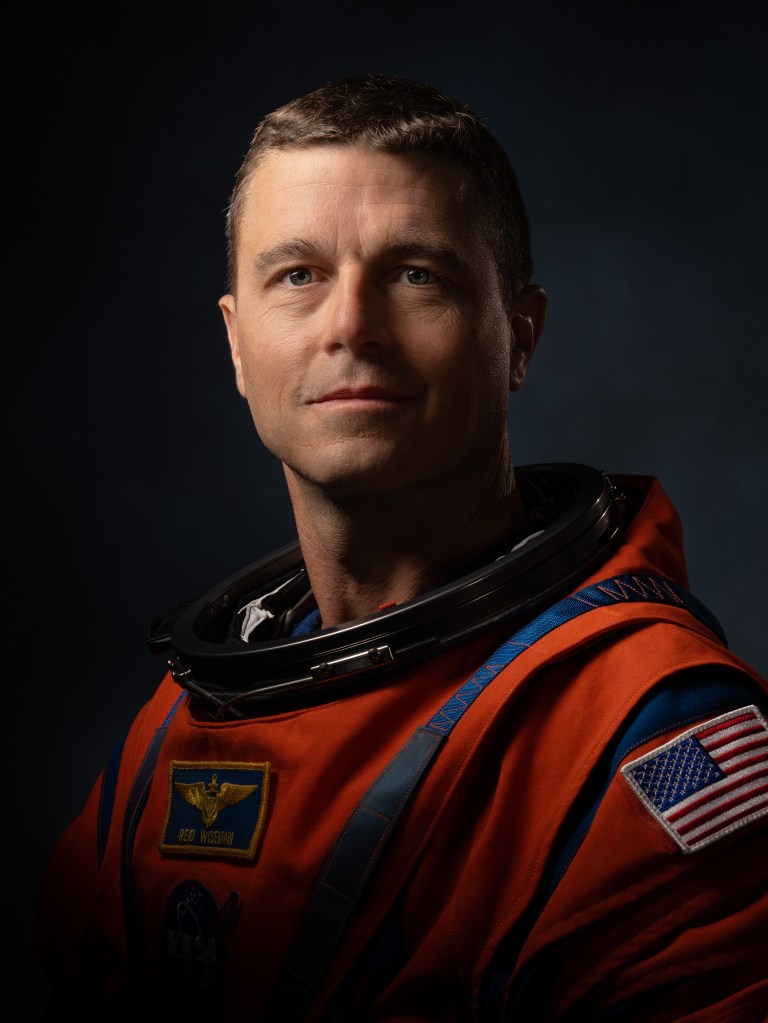
Reid Wiseman
Commander
Command authority, mission leadership, and operational discipline from ascent through recovery.

Victor Glover
Pilot
Vehicle operations, piloting demonstrations, and cockpit workload during critical trajectory events.
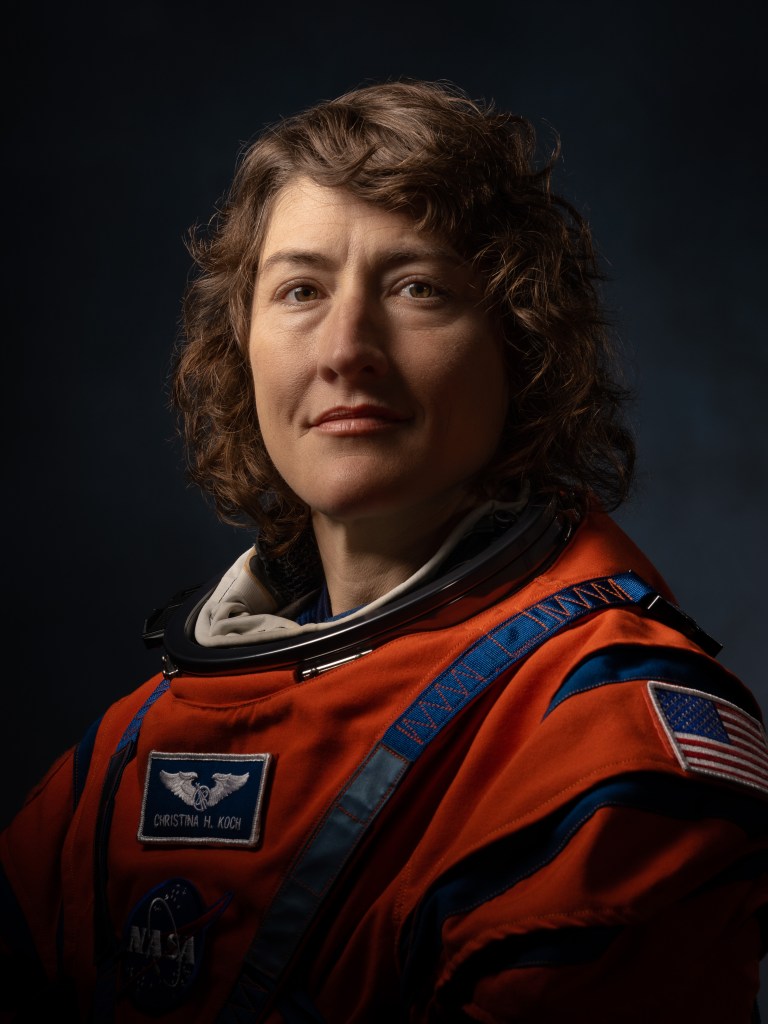
Christina Koch
Mission Specialist
Crew systems work, lunar observation support, and human-performance validation in deep space.
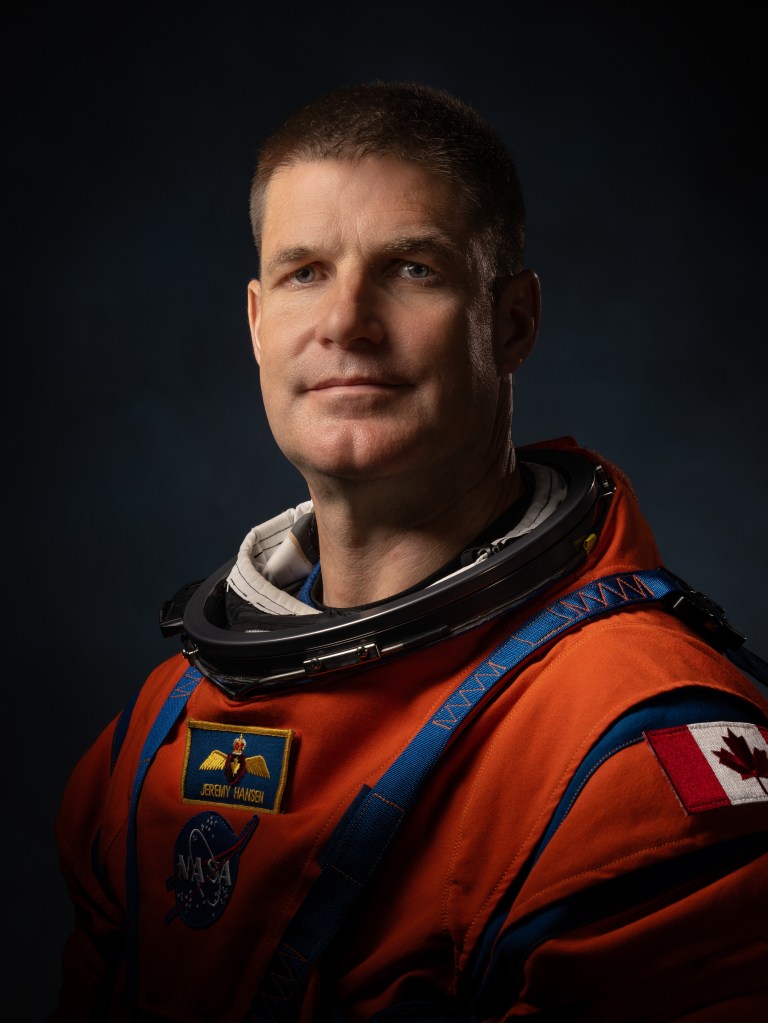
Jeremy Hansen
Mission Specialist
CSA astronaut contributing to mission operations, crew procedure execution, and the international dimension of Artemis.
Official NASA updates archive
Public posts reorganized into a cleaner mission surface.
This archive is built from NASA's public Artemis II mission pages and flight-day posts, then grouped into mission phases for readability.
Artemis II Launch Day Updates
Live launch-day coverage captured liftoff, booster separation, and Orion solar array wing deployment as the mission transitioned from ascent into orbital operations.
Artemis II Flight Day 2: Orion Completes TLI Burn, Crew Begins Journey to the Moon
NASA confirmed the translunar injection burn that committed Orion to deep space and began the crewed trip from Earth orbit toward the Moon.
Artemis II Flight Day 3: Outbound Trajectory Correction Burn Update
The first outbound correction burn was canceled because Orion was already on the right flight path, a useful reminder that precision can mean not firing at all.
Artemis II Flight Day 3: Crew Prepares Cabin for Lunar Flyby
With the mission more than halfway to the Moon, the crew shifted toward camera setup, lunar observations, emergency procedures, and cabin choreography for the flyby window.
Artemis II Flight Day 4: Deep-Space Flying, Lunar Flyby Prep
NASA outlined manual piloting demonstrations, lunar science targeting, a planned far-side communications blackout, and the shape of the upcoming flyby geometry.
Artemis II Flight Day 5: Crew Starts Day with Suit Demo
The crew evaluated the Orion Crew Survival System suits in microgravity, tying human performance directly to cabin depressurization response and post-splashdown survival.
Artemis II Flight Day 5: Correction Burn Complete
A short outbound correction burn refined Orion's path, and NASA published the flyby milestone schedule including closest approach, record distance, Earthset, and eclipse timing.
Artemis II Flight Day 6: Crew Ready for Lunar Flyby
NASA marked entry into the lunar sphere of influence and framed the flyby as the first human return to lunar proximity since Apollo 17.
Artemis II Flight Day 6: Crew Wraps Historic Lunar Flyby
The crew set a new human distance record, completed a seven-hour lunar flyby, and photographed the lunar far side before beginning the return arc.
Artemis II Flight Day 7: Crew Makes Long-Distance Call, Begins Return
NASA published the Earthset image and began documenting the first leg of the return coast after Orion exited the Moon's dominant gravity field.
Artemis II Flight Day 7: First Return Correction Burn Complete
A short 15-second burn nudged Orion onto the next segment of its path home and confirmed that return navigation would be handled with precise, low-magnitude adjustments.
Artemis II Flight Day 8: Crew Conducts Key Tests on Return to Earth
The crew focused on health countermeasures, manual piloting plans, and entry prep while the mission transitioned from lunar return to Earth return operations.
Artemis II Flight Day 9: Crew Prepares to Come Home
The last full day in space focused on return configuration, onboard routine, and the shift from long-duration transit to descent discipline.
Artemis II Flight Day 10: Crew Sets for Final Burn, Splashdown
NASA published the final descent timeline, including module separation, blackout, parachute events, peak G-loading, and targeted splashdown timing.
Artemis II Flight Day 10: Crew Completes Final Burn Before Splashdown
A final 8-second burn sharpened Orion's entry geometry and closed the loop between long-range navigation and the narrow corridor required for return.
Artemis II Flight Day 10: Live Re-Entry Updates
NASA logged atmospheric interface, plasma blackout, parachute deployment, splashdown, crew extraction, and the handoff from spacecraft operations to recovery operations.
Mission imagery and Earthset gallery
A visual sequence, not a random masonry wall.
Earthset anchors the memory of the mission, but the launch, mission control, cabin, and recovery images matter because they show how many different layers had to hold together for the arc to close.
Earthset From the Lunar Far Side
↗Captured through Orion's window at 6:41 p.m. EDT on April 6, 2026, during the lunar flyby. Earth drops behind the cratered far-side terrain and becomes the mission's emotional centerline.
SLS and Orion Lift Off From Launch Complex 39B
↗The mission begins with raw force and staging discipline. The visual is about ignition, but the engineering meaning is velocity, guidance, and orbital geometry.

White Flight Control Tracks the Mission
↗Human spaceflight stays legible because teams on the ground turn telemetry, communications, and procedures into decisions. This image anchors the systems layer, not just the crew layer.
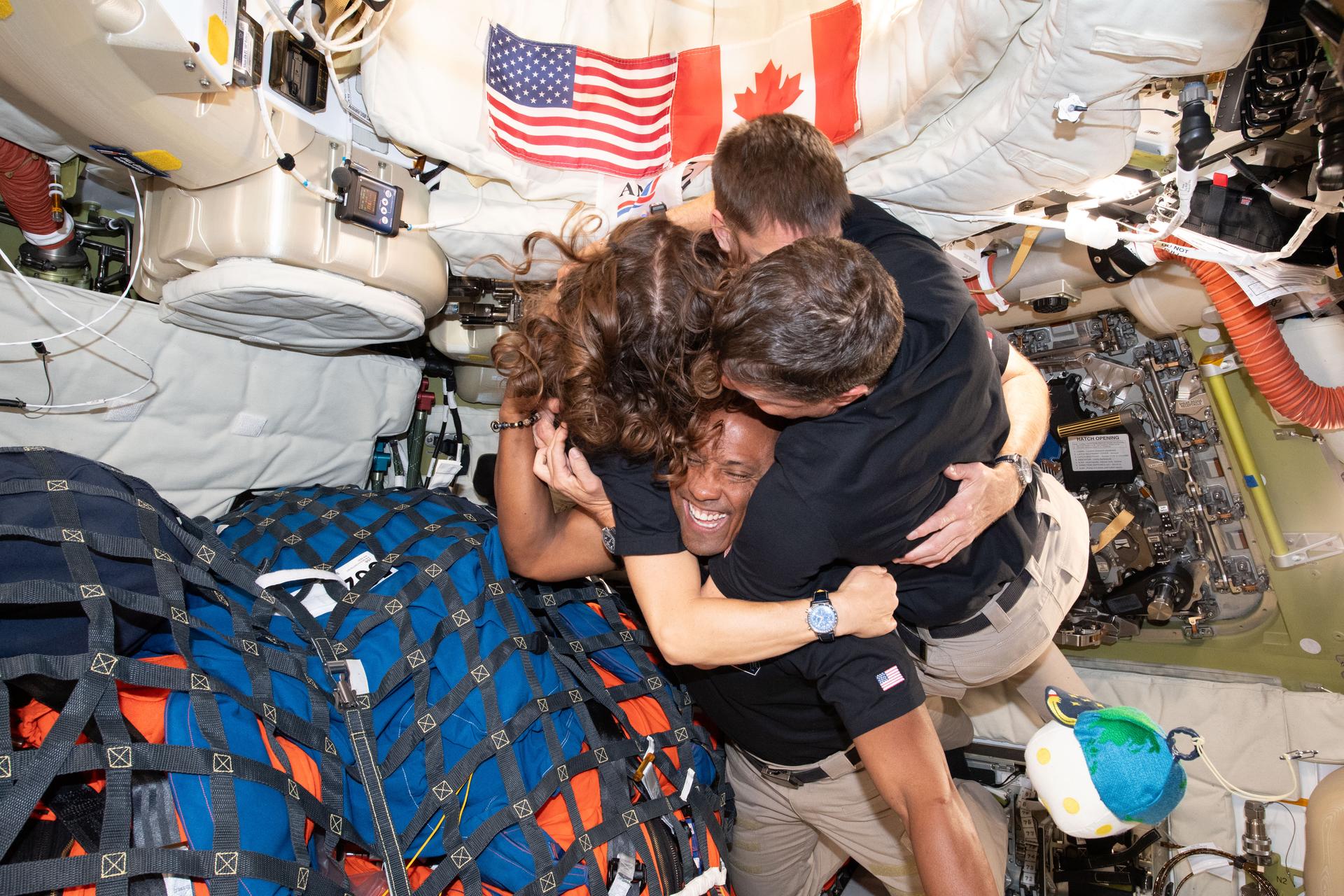
Crew Inside Orion on the Way Home
↗Inside the capsule, the mission turns from spectacle into procedure: fatigue management, routine, communications, and the quiet discipline of a crew still in transit.
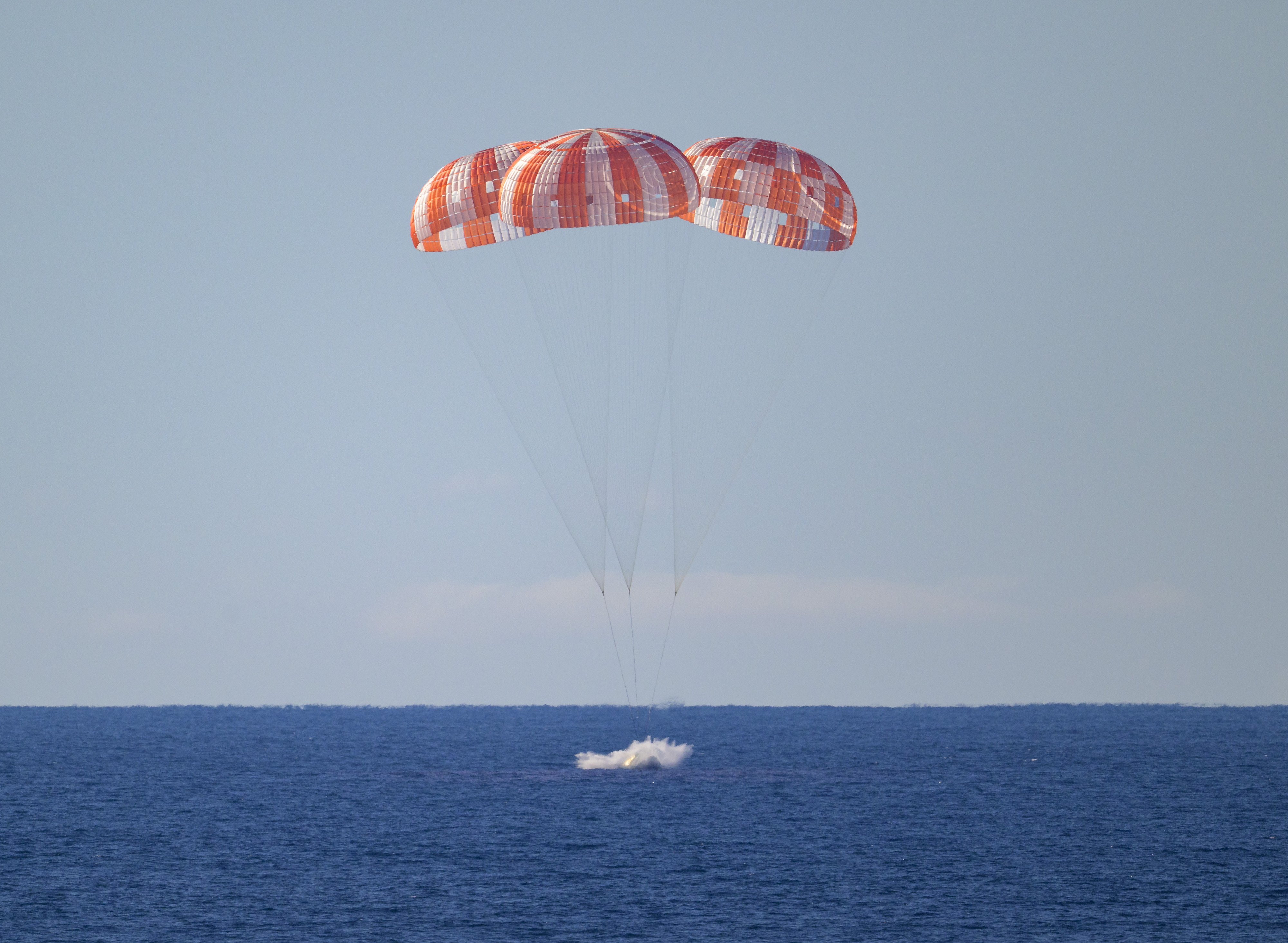
Orion in the Pacific After Splashdown
↗The last phase is not just landing. It is controlled deceleration handed from heat shield to parachutes to recovery divers, aircraft, and shipboard teams.
Source methodology
Editorially assembled, source-linked, and explicit about what is interpretation.
Mission phases are editorial groupings assembled from NASA's public Artemis II mission pages, daily mission blogs, and gallery coverage.
Timeline copy and key figures are tied to NASA's public launch, lunar flyby, and splashdown reporting for April 1 to April 10, 2026.
Physics notes are explanatory interpretation, not official NASA copy. They stay close to orbital mechanics, entry dynamics, and vehicle operations rather than classroom formalism.
Media references point back to official NASA sources. This site is a public educational archive and is not an official NASA product.
Closing
Not the end of Artemis. But the return of distance.
Artemis II compressed launch energy, orbital mechanics, systems engineering, flight control, human discipline, and recovery operations into one arc around the Moon and back. This archive exists as a record of that passage, and as a reminder that every deep-space mission is also a story about what humanity is willing to build, verify, and risk in order to go farther.
“I hardly know how to react, but the Artemis II crew was exceptional. This website was built for them, and I hope I get to witness the Artemis III mission too.”